The International Federation of Accountants (IFAC) today announced that Lee White has been named to succeed Kevin Dancey as CEO. Mr. White will assume his new post in March 2024 and will be based in London.
Mr. White, who has been with the IFRS Foundation since 2018, has more than 30 years of global executive, regulatory and leadership experience. A chartered accountant, Mr. White has most recently led the creation of the International Sustainability Standards Board (ISSB) within the IFRS Foundation and the launch of the ISSB’s first two standards in June. Mr. White is an avid champion of the role of professional accountants in driving and delivering high-quality sustainability-related disclosure and assurance.
Before joining the IFRS Foundation, Mr. White spent nine years at Chartered Accountants Australia and New Zealand (CAANZ), including six years as its CEO, having been instrumental in the successful merger of the Institute of Chartered Accountants Australia (ICAA) with CAANZ. Earlier in his career, Mr. White was Chief Accountant of the Australian Securities and Investments Commission (ASIC) during which time he was directly involved in the creation of the International Forum of Independent Audit Regulators (IFIAR).
On the occasion of his appointment, Mr. White said, “I am delighted with and humbled by the opportunity ahead. Engagement of the global accounting profession has never been more critical if society is to address many of the world’s most pressing economic and environmental issues. I look forward to leading our profession in a way that will continue to serve a vital public interest role, and also to raising awareness about the extraordinary opportunities available to accountants today.”
Asmâa Resmouki, President of IFAC, said, “We are very fortunate to have secured a leader of Lee’s caliber to take IFAC on the next chapter of its journey, and I would like to thank IFAC’s CEO Search Committee for their efforts in identifying the best candidate for the role. Lee’s deep knowledge of IFAC, his global business acumen and his commitment to the public interest promise to serve the profession, and indeed all of IFAC’s stakeholders, very well.”
About IFAC IFAC is the global organization for the accountancy profession dedicated to serving the public interest by strengthening the profession and contributing to the development of strong international economies. IFAC is comprised of 180 members and associates in more than 135 jurisdictions, representing millions of professional accountants in public practice, education, government service, industry, and commerce.
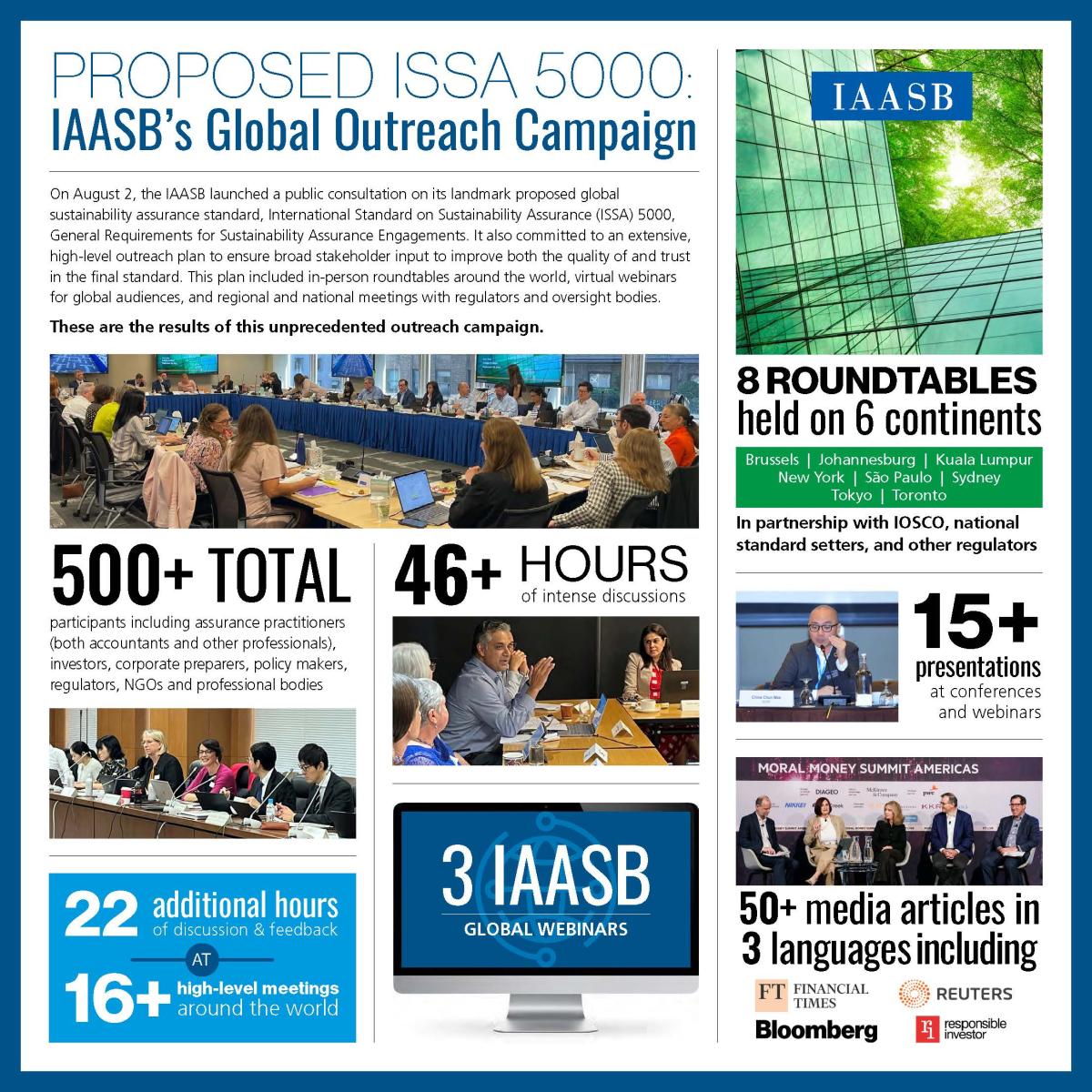
On August 2, the International Auditing and Assurance Standards Board (IAASB) launched a public consultation on its landmark proposed global sustainability assurance standard, International Standard on Sustainability Assurance (ISSA) 5000, General Requirements for Sustainability Assurance Engagements. It also committed to an extensive, high-level outreach plan to ensure broad stakeholder input to improve both the quality of and trust in the final standard. This plan included in-person roundtables around the world, virtual webinars for global audiences, and regional and national meetings with regulators and oversight bodies.
These are the results of this unprecedented outreach campaign:
The International Federation of Accountants (IFAC) and Chartered Accountants Australia and New Zealand (CA ANZ) released a quality management toolkit today to help small- and medium-sized practices (SMPs) implement the International Auditing and Assurance Standards Board’s (IAASB) suite of quality management standards.
The Quality Management Toolkit for Small- and Medium-Sized Firmsand its companionIllustrative Risk Matrix include a suite of illustrative documents, policies, checklists, sample letters and forms to help SMPs establish their quality objectives, identify and assess quality risks, and design and implement responses to address their identified quality risks. The toolkit is designed to require each SMP to adapt the content to its nature, circumstances, and engagements, a crucial element given each firm goes through its own unique process developing its quality management system.
Kevin Dancey, IFAC CEO, said: “Many SMPs face resource constraints that affect implementing the IAASB’s quality management standards, given the new standards require a more proactive and tailored approach to managing quality across firms of all sizes. By partnering with CA ANZ to adapt its excellent original materials for an international audience, we are providing SMPs, and the professional accountancy organizations that support them, with a clear roadmap to understanding and applying the standards to drive overall quality.”
Ainslie van Onselen, CA ANZ CEO and Chair-Elect of Chartered Accountants Worldwide, said: “High-quality audits are crucially important for enterprises of all sizes in markets around the world. Based on our experience using a similar approach in Australia and New Zealand, this toolkit will help SMPs implement the quality management standards and ensure that a commitment to quality is at the center of a firm’s strategy, operation, and service delivery for audits and other engagements. We are pleased to partner with IFAC to deliver these materials to the global accountancy profession. Our Australian and New Zealand version was well received and we hope this global version will be valuable to SMPs around the world.”
Individual practitioners can tailor and reproduce the quality management toolkit for non-commercial use without permission from IFAC. Otherwise, permission is required to reproduce, store, or transmit, or to make similar uses of the toolkit. Contact permissions@ifac.org. IFAC member organizations are invited to submit a permission request to provide their members with the toolkit, including adding their logo, as long as appropriate acknowledgement of IFAC and CA ANZ is included with the copyright notice.
This quality management toolkit joins IFAC’s collection quality management resources, including webinars, articles and videos, as well as the IAASB first-time implementation guides, all of which are available at ifac.org/qualitymanagement.
IFAC acknowledges and appreciates feedback from IFAC’s Small and Medium Practices Advisory Group and the Forum of Firms representatives in the development of the toolkit.
About IFAC IFAC is the global organization for the accountancy profession dedicated to serving the public interest by strengthening the profession and contributing to the development of strong international economies. IFAC is comprised of 180 members and associates in more than 135 jurisdictions, representing millions of professional accountants in public practice, education, government service, industry, and commerce.
About CA ANZ CA ANZ represents more than 136,000 Members around the world, offering its flagship CA Program, promoting the CA designation and high ethical standards and delivering world class services and lifelong education to its Members and advocates for the public good.
Original CA ANZ Toolkit Modified for International Users
The Q&A publication is designed to highlight, illustrate, or explain aspects of the revisions in the Code and is intended to complement the Basis for Conclusions for the final pronouncement. It will assist firms, national standards setters, and professional accountancy organizations in adopting and/or implementing the revisions. The Q&As will also assist regulators and audit oversight bodies, the corporate governance community, investors, preparers, educational bodies or institutions, and other stakeholders in understanding the revisions to the Code.
The development of the Q&As has been informed by the IESBA’s extensive discussions and consultations with a wide range of stakeholders and the IESBA’s own deliberations during the development and finalization of the pronouncement.
The pronouncement is coming into effect for audits of financial statements and group financial statements for periods beginning on or after December 15, 2023, with early adoption permitted.
Across the globe momentum is building for sustainability reporting and assurance in the public sector. The IPSASB decided to move forward with the development of public sector specific sustainability reporting standards beginning with a Climate-Related Disclosures standard. Finance and audit professionals working in government, public sector bodies and supreme audit institutions – Auditors-General’s offices, Courts of Accounts and similar (SAIs) – can demonstrate leadership on this agenda, driving action to progress transparent reporting and assurance of expenditure and actions to address sustainability challenges.
At the World Investment Forum in Abu Dhabi on 16th October three global bodies, ACCA, IFAC and IDI launched a summary of their forthcoming introduction to sustainability and assurance in the public sector.
Based on their ongoing work and recent global roundtables with public sector reporting and auditing experts, the report makes the case for a focus on the principle of sustainable development: "meeting the needs of the present without compromising the ability of future generations to meet their own need." It outlines what sustainability reporting and assurance mean for the public sector, why they are important, and key principles for governments, SAIs and other public sector bodies to consider in this journey.
Speaking at the ACCA/UN symposium on developing public sector sustainability reporting, Maggie McGhee, Executive director for Strategy and Governance at ACCA said, "A sustainable future for all is a primary concern across government activity. At the same time governments play a critical role in establishing good governance: the institutional, policy and regulatory frameworks in which society operates. So governments and other public sector bodies need to be able to measure and report on how their policies and expenditure are addressing sustainability challenges."
Laura Leka, Principal and public sector lead at IFAC said, "Policymakers and other stakeholders, including the public, need information to understand the sector’s impact on sustainable development. It’s important that sustainability reporting provides disclosures that are high-quality, decision-useful, and prepared in accordance with internationally recognized reporting and disclosure standards."
As sustainability reporting develops, independent external assurance will become increasingly necessary to build trust in the information being disclosed. Roundtable participants saw SAIs taking the lead, building on their experience auditing progress towards sustainable development.
Archana Shirsat, Deputy Director General at IDI, said, "SAIs have a central role to play in providing independent and objective oversight on sustainability information generated by the public sector. Determining appropriate forms of assurance or confidence, engaging with stakeholders and developing auditor competencies to audit sustainability information is important to build public trust."
We are ACCA (the Association of Chartered Certified Accountants), a globally recognised professional accountancy body providing qualifications and advancing standards in accountancy worldwide.
Founded in 1904 to widen access to the accountancy profession, we’ve long championed inclusion and today proudly support a diverse community of over 247,000 members and 526,000 future members in 181 countries.
Our forward-looking qualifications, continuous learning and insights are respected and valued by employers in every sector. They equip individuals with the business and finance expertise and ethical judgment to create, protect, and report the sustainable value delivered by organisations and economies.
Guided by our purpose and values, our vision is to develop the accountancy profession the world needs. Partnering with policymakers, standard setters, the donor community, educators and other accountancy bodies, we’re strengthening and building a profession that drives a sustainable future for all.
The INTOSAI Development Initiative (IDI) is an autonomous implementing body that is not-for-profit. Its mandate is to provide support to Supreme Audit Institutions (SAIs) in developing countries to enhance their performance and capacity in a sustainable manner. The work done by IDI is based on the needs and challenges experienced by SAIs. The support provided is focused on a needs-based and sustainable approach. IDI seeks to empower SAIs by promoting gender-responsiveness and peer-to-peer cooperation as essential elements of long-term capacity development.
In each country, there is a Supreme Audit Institution that is tasked with auditing public funds to ensure that it is an effective, accountable, and inclusive institution. IDI is convinced that its contribution to strengthening Supreme Audit Institutions can make a difference in the lives of citizens for several reasons. Firstly, government audits are key components of effective public financial management and good governance. Secondly, SAIs contribute to the quality of government engagement and better state-society relations through their work. Lastly, SAIs are key stakeholders in supporting the implementation of Sustainable Development Goals (SDGs).
IFAC is the global organization for the accountancy profession dedicated to serving the public interest by strengthening the profession and contributing to the development of strong international economies. IFAC is comprised of 180 members and associates in more than 135 jurisdictions, representing millions of professional accountants in public practice, education, government service, industry, and commerce.
The International Auditing and Assurance Standards Board (IAASB) has released amendments aimed at bolstering transparency and providing auditors with a clear mechanism to action changes to the International Ethics Standards Board for Accountants’ (IESBA) Code of Ethics for Professional Accountants (including International Independence Standards). The IAASB amended International Standard on Auditing 700 (Revised), Forming an Opinion and Reporting on Financial Statements and ISA 260 (Revised), Communication with Those Charged with Governance.
The IESBA Code now requires firms to publicly disclose when a firm has applied the independence requirements for public interest entities in an audit of the financial statements of an entity. The IAASB’s amendments provide a clear and practical framework for implementing this new requirement through appropriate communication in the auditor’s report and with those charged with governance.
Throughout the development of these amendments, the IAASB maintained close collaboration and coordination with IESBA, striving to align key concepts in the IAASB’s and IESBA’s standards, to the greatest extent possible.
The revisions relating to (a) the definition of engagement team, and (b) group audits. The revisions deal with the independence and other implications of the changes made to the definition of “engagement team” in the Code to align with changes to the definition of the same term in the IAASB’s International Standards on Auditing (ISAs) and International Standards on Quality Management (ISQMs). The revisions also address holistically the various independence considerations in an audit of group financial statements. The revised provisions relating to the definition of engagement team and group audits will be effective for audits of financial statements and audits of group financial statements for periods beginning on or after December 15, 2023. Early adoption of the revisions is encouraged.
The upcoming expiry of the “jurisdictional provision” addressing long association of personnel with an audit client. The jurisdictional provision will expire and be no longer available for audits of financial statements for periods beginning on or after December 15, 2023. Under the jurisdictional provision (paragraph R540.20 of the Code), where a legislative or regulatory body (or organization authorized or recognized by such legislative or regulatory body) has established a cooling-off period for an engagement partner of less than five consecutive years, that shorter cooling-off period may be applied, subject to a floor of three years, provided that the applicable time-on period does not exceed seven years.
The back of the 2023 Handbook contains the IESBA-approved revisions to the Code, which are not yet effective. These revisions will become effective in December 2024 and include:
Changes to the definitions of “audit client” and “group audit client” in the Glossary arising from the approved revisions to the definitions of listed entity and PIE.
Reproducing and Translating the IESBA Handbook To help adoption and implementation of the IESBA standards, stakeholders are invited to submit requests for permission to reproduce or translate the IESBA Handbook online via the Online Permissions Requests or Inquiries system on the IFAC website.
The International Ethics Standards Board for Accountants (IESBA) is an independent global standard-setting board. The IESBA’s mission is to serve the public interest by setting high-quality, international ethics (including independence) standards as a cornerstone to ethical behavior in business and organizations, and to public trust in financial and non-financial information that is fundamental to the proper functioning and sustainability of organizations, financial markets and economies worldwide.
In September 2023, the United Nations will mark the half-way point to the deadline set for achieving the 2030 Agenda and the Sustainable Development Goals. This is an important juncture for global leaders to reflect on the progress we have made, the progress we have not made, and the challenges we face ahead.
Reflecting on the G20’s current theme of One Earth, One Family, One Future, IFAC, acting in its role as the global voice of the accountancy profession, highlights the importance of inclusivity in underpinning sustainable development in its 2023 Call to Action. We must approach sustainability, the public sector, small- and medium-sized entities (SMEs), and education with an inclusive approach to make sure that the opportunities of today and tomorrow are shared, and that economic and social development are truly sustainable.
“We have serious challenges ahead of us. Fortunately, the global accountancy profession is a committed partner, doing our part to drive sustainable development and demonstrating leadership as a truly global and inclusive profession,” said IFAC CEO Kevin Dancey.
IFAC calls on G20 leaders to:
1. Make Sustainability A Reality, Not Just a Goal
Lead on achieving the UN SDGs and provide a foundation for net zero transitions
Support the ISSB's global baseline for sustainability disclosures
Support mandatory assurance of sustainability information pursuant to ISSA 5000
Support the work of the International Public Sector Accounting Standards Board to develop sustainability reporting standards for the public sector
2. Support Public Financial Management and Fight Corruption
Support high-quality public financial management, professionalization in the public sector, and accrual accounting at all levels of government
Continue to prioritize full adoption and implementation of global commitments on the fight against corruption, such as the G20 Anti-Corruption Action Plan
3. Create an Environment for SME Growth and Innovation
Embed the unique needs of SMEs into global policy making
Support access to digital infrastructure and skills for SMEs
Provide a supportive regulatory environment for SMEs
4. No Inclusive Growth without Education
Support equal access to education, including STEM (science, technology, engineering and math) and accounting skills
Support financial literacy globally and locally
About IFAC IFAC is the global organization for the accountancy profession dedicated to serving the public interest by strengthening the profession and contributing to the development of strong international economies. IFAC is comprised of 180 members and associates in more than 135 jurisdictions, representing millions of professional accountants in public practice, education, government service, industry, and commerce.
Inclusive approach to key global challenges—like sustainability and education—necessary to achieve the UN SDGs
The digitally interactive report looks back at 2022 through the eyes of the international ethics standard-setting board, complete with detailed reports on the Board’s projects alongside reflective remarks from its leaders. The report showcases a board in transition, completing long-running projects aimed at further strengthening the IESBA’s International Code of Ethics for Professional Accountants (including International Independence Standards)(the Code), addressing the ethical implications of rapid technological advances, and moving fast to develop the necessary ethics and independence standards for sustainability reporting and assurance, always working to serve the public interest.
“IESBA’s work in 2022 will ultimately strengthen the public’s trust in the professional accountant, corporate reporting and businesses more generally at a time of rapid change and complexity,” said IESBA Chair Gabriela Figueiredo Dias. “Collectively, we’ve ensured the necessary strategic adjustments to better serve the public interest in a context of complex developments that we face today, like sustainability and technology, through our actions to enhance our global ethics and independence standards, thereby raising the bar for ethical conduct and practice for all professional accountants and other service providers that may want to use our standards.”
Beyond the updates on IESBA projects, the 2022 IESBA Report features an overview of the Board’s extensive stakeholder outreach efforts and information about its efforts to promote global adoption and effective implementation of the Code. The Report also includes a message from the IESBA’s Consultative Advisory Group (CAG) Chair, Mr. Gaylen Hansen.
About IESBA
The International Ethics Standards Board for Accountants serves the public interest by setting high-quality ethics standards, including independence requirements, as a cornerstone to ethical behavior in business and organizations, and to public trust in financial and non-financial information that is fundamental to the proper functioning and sustainability of organizations, financial markets and economies worldwide.
Along with the International Auditing and Assurance Standards Board (IAASB), the IESBA is part of the International Foundation for Ethics and Audit (IFEA). The Public Interest Oversight Board (PIOB) oversees IESBA and IAASB activities and the public interest responsiveness of the standards. For copyright, trademark, and permissions information, please visit Permissions.
Showcases global ethics board’s 2022 achievements strengthening international ethics and independence standards while pivoting to serve the public interest in emerging areas
“Our proposed ISSA 5000 is a crucial step in enhancing confidence and trust in sustainability reporting. This proposal directly responds to the International Organization of Securities Commissions recommendations and complements the work of other standard setters, including the International Ethics Standards Board for Accountants,” noted IAASB Chair Tom Seidenstein. “Corporate reporting, whether financial or sustainability focused, is more trusted when it receives external and independent assurance based upon globally accepted standards independently developed in the public interest.”
ISSA 5000 is a principles-based, overarching standard suitable for both limited and reasonable assurance engagements on sustainability information reported across any sustainability topic. The IAASB drafted the standard to work with sustainability information prepared under any suitable reporting framework. These frameworks include the many reporting frameworks already in place and those under development, including but not limited to those issued by the European Union, the International Sustainability Standards Board, the Global Reporting Initiative, the International Organization for Standardization, and others. The standard is profession agnostic, supporting its use by both professional accountant and non-accountant assurance practitioners when performing high quality sustainability assurance engagements.
The IAASB is committed to an extensive, high-level outreach plan to ensure broad stakeholder input. One core element of the outreach is a series of four roundtables beginning in September. The IAASB will also take part in virtual, regional, and national events, many held in partnership with other organizations, throughout the consultation period.
“Receiving the broadest range of views from our stakeholders will improve both the quality of and trust in the final standard. Our unprecedented commitment to outreach will allow us to engage directly with a much wider group of stakeholders to gather the valuable insights we need to finalize a high-quality robust standard,” noted IAASB Vice-Chair and Sustainability Task Force Chair Josephine Jackson.
ISSA 5000 will be available French, Japanese, Portuguese, and Spanish in the coming weeks. The IAASB invites all stakeholders to comment on the proposed revisions via the IAASB website by December 1, 2023.
Proposed International Standard on Sustainability Assurance 5000 Suitable for Use by All Assurance Practitioners