  • New Edition of the International Framework: Good Governance in the Public Sector Released by IFAC and CIPFA

    New York, New York | Worldwide English

    The International Federation of Accountants (IFAC) and the Chartered Institute of Public Finance and Accountancy (CIPFA) released the 2026 Edition of the International Framework: Good Governance in the Public Sector.
    Image
    IFAC-CIPFA-GGF-Cover
     

    Good governance ensures that public sector entities define and achieve their intended outcomes while acting in the public interest at all times. It enables them to serve with integrity, transparency, and accountability, building trust in public institutions and reducing the risk of fraud and corruption. Grounded in clear values, proportionate controls, and respect for the rule of law, good governance supports inclusive engagement, informed decisions, and the efficient and effective use of public resources.

    The 2026 Edition updates the original 2014 Framework to reflect developments over the past decade and ensure its continued relevance in today’s environment, including progress in sustainability reporting. The Framework remains principles-based and structured around seven high-level, interrelated principles for good governance, designed to apply to all entities in the public sector.

    Lee White, IFAC Chief Executive Officer, said: “The Framework reaffirms that good governance enables public sector entities to deliver meaningful outcomes for current citizens while protecting the interests of future generations. By providing a globally recognized benchmark, it supports IFAC members in advancing high-quality practices and strengthening trust in public institutions worldwide."

    Owen Mapley, CIPFA Chief Executive Officer, said: “The 2026 Edition maintains the Framework’s clear focus on principles, but presents them in a more concise, practical, and action-oriented format. It provides governments and public sector leaders with an adaptable and accessible tool to support improvement and accountability.”

    Each of the seven principles is accompanied by a set of questions designed to prompt critical thinking and meaningful discussion among leadership teams. The Framework is intended as a diagnostic and developmental tool to support entities, reviewers, and advisors in assessing governance practices, identifying areas of strength, and planning improvements. It complements jurisdictional or sectoral governance codes, serving as a useful reference to those developing, updating, or reviewing such codes.
    Image
    IFAC-CIPFA-GGF-webinar


    The updated Framework will be utilized in community discussions around the globe and explored in depth at a global webinar May 6, 2026 at 13:00 UTC. Register now for From Principles to Practice: The 2026 Framework for Good Governance in the Public Sector. 

    Download the 2026 Edition of the International Framework: Good Governance in the Public Sector.

    About IFAC

    IFAC, by connecting and uniting its members, makes the accountancy profession truly global.

    IFAC member organizations are champions of integrity and professional quality, and proudly carry their membership as a badge of international recognition.

    IFAC and its members work together to shape the future of the profession through learning, innovation, a collective voice, and commitment to the public interest.

    About CIPFA

    The Chartered Institute of Public Finance and Accountancy (CIPFA) is the professional body for people in public finance, promoting excellence in public financial management and governance worldwide.

  • IPSASB Seeks Public Feedback on Proposed Updates Linking Accounting and Government Finance Statistics

    English

    The International Public Sector Accounting Standards Board® (IPSASB®), developer of IPSAS® Accounting Standards, has issued a proposal for public comment: IPSAS Exposure Draft (ED) 94, Linkages Between IPSAS Standards and the Government Finance Statistics Manual 2014 (Amendments to IPSAS 22)

    Governments use IPSAS Accounting Standards to prepare financial statements, and they use the Government Finance Statistics Manual 2014 (GFSM 2014) to compile statistical reports. The proposed guidance in IPSAS ED 94 will benefit entities that are either in the process of implementing or are already applying IPSAS Standards by providing a tool to plan the integration between accounting and statistical systems to enable the usage of IPSAS Standards-based accounting data as a source for GFSM 2014 reporting.

    “The guidance we are proposing will help governments leverage the independently audited accounting data that is already available in their systems for statistical compilation, enhancing the overall data quality and the efficiency of their statistical reporting process,” said IPSASB Chair Thomas Müller-Marqués Berger. “Utilizing the accounting data to support better decisions and fiscal management by governments benefits everyone.”

    The final pronouncement will amend IPSAS 22, Disclosure of Financial Information About the General Government Sector, which prescribes disclosure requirements for governments that elect to present information about the General Government Sector in their consolidated financial statements.

    The IPSASB welcomes public comments on IPSAS ED 94. Comments received will help shape the final pronouncement.

    How to Access

    Access IPSAS ED 94, Linkages Between IPSAS Standards and the Government Finance Statistics Manual 2014 (Amendments to IPSAS 22), its summary At-a-Glance document, or submit a comment. Comments on the ED are requested by June 22, 2026. The IPSASB encourages IFAC members, associates, and Network Partners to promote the availability of this ED to their members and employees.

    About the IPSASB

    The International Public Sector Accounting Standards Board (IPSASB®) works to improve public sector financial reporting worldwide through the development of IPSAS® Accounting Standards, IPSASB SRS™ Standards, and other high-quality financial reporting guidance for use by governments and other public sector entities. It also raises awareness of IPSAS Standards and IPSASB SRS Standards and promotes the adoption and implementation of these to enhance the quality and consistency of practice throughout the world and strengthen the transparency and accountability of public sector finances and sustainable development. The Board receives support from the Asian Development Bank, the Chartered Professional Accountants of Canada, the New Zealand External Reporting Board, the government of Canada, and The World Bank. The structures and processes that support the operations of the IPSASB are facilitated by the International Federation of Accountants (IFAC®). For copyright, trademark, and permissions information, please go to permissions or contact permissions@ifac.org.

    About the Public Interest Committee

    The governance and standard-setting activities of the IPSASB are overseen by the Public Interest Committee (PIC), to ensure that they follow due process and reflect the public interest. The PIC is comprised of individuals with expertise in public sector or financial reporting, and professional engagement in organizations that have an interest in promoting high-quality and internationally comparable financial information.

    Stakeholder Comments on IPSAS Exposure Draft 94 Sought by June 22, 2026

  • IPSASB Issues First Ever Public Sector Standard for Climate-related Disclosures

    New York, New York English

    Governments face risks related to climate change and extreme weather events. However, there was a lack of clear public sector guidance on how to disclose them and inform accountability and decision-making.

    To address this gap, the International Public Sector Accounting Standards Board (IPSASB) today issued IPSASB SRS 1, Climate-related Disclosures, the first-ever public sector standard to help governments and public sector entities report climate-related risks and opportunities clearly and consistently.

    IPSASB SRS 1 was developed with support from the World Bank, which works to create a world free of poverty on a livable planet through a combination of financing, knowledge, and expertise.

    “Governments play a fundamental role in climate action, as their decisions can shape outcomes across the entire economy”, said IPSASB Chair Thomas Müller-Marqués Berger. “Climate-related information is therefore essential for stronger public financial management as it provides insights into the climate-related risks and opportunities to governments’ operations. By doing so, the new disclosures enable efficient access to capital markets to mobilize the additional financing needed for climate resilience.”

    “We are very happy to collaborate with IPSASB and support the development of these new sustainability reporting standards for the public sector,” said Arturo Herrera, World Bank Global Director for Governance. “In the past, the focus of sustainability reporting has been on the private sector. With the public sector responsible for a significant share of global emissions, these new standards represent an important opportunity to make more complete climate-related information available to the public.”

    IPSASB SRS 1 is aligned with IFRS S2 to enhance the consistency and comparability of climate-related disclosures across the public and private sectors for market participants, in particular for lenders and other resource providers.  

    Access IPSASB SRS 1, Climate-related Disclosures. IPSASB SRS 1 applies to an entity’s general purpose financial reports for annual reporting periods beginning on or after January 1, 2028. Earlier adoption is permitted.

    Learn more at the IPSASB’s webinar

    To support adoption, IPSASB will host a global webinar on February 12, 2026, 8:00–9:00 a.m. EST (13:00–14:00 UTC), where participants can learn about the standard, ask questions, and explore practical implementation strategies. Register now. [UPDATE: Watch the recording.]

    About the IPSASB

    The International Public Sector Accounting Standards Board (IPSASB) works to strengthen public financial management globally through developing and maintaining accrual-based International Public Sector Accounting Standards (IPSAS Standards), IPSASB Sustainability Reporting Standards (IPSASB SRS™ Standards) and other high-quality financial reporting guidance for use by governments and other public sector entities. It also raises awareness of IPSAS Standards and IPSASB SRS Standards and promotes the adoption and implementation of these to enhance the quality and consistency of practice throughout the world and strengthen the transparency and accountability of public sector finances and sustainable development. The Board receives support from the Asian Development Bank, the Chartered Professional Accountants of Canada, the New Zealand External Reporting Board, the government of Canada, and The World Bank. The structures and processes that support the operations of the IPSASB are facilitated by the International Federation of Accountants (IFAC®). For copyright, trademark, and permissions information, please go to permissions or contact permissions@ifac.org.

    About the World Bank

    The World Bank Group works to create a world free of poverty on a livable planet through a combination of financing, knowledge, and expertise. It consists of the World Bank, including the International Bank for Reconstruction and Development (IBRD) and the International Development Association (IDA); the International Finance Corporation (IFC); the Multilateral Investment Guarantee Agency (MIGA); and the International Centre for Settlement of Investment Disputes (ICSID). For more information, please visit worldbank.org, ida.worldbank.org, miga.org, ifc.org, and icsid.worldbank.org.

    Funding for the project is through the World Bank’s Financial Management Umbrella Program. The Program is supported by the Australian Department of Foreign Affairs and Trade, the Government of Austria, the Bill & Melinda Gates Foundation, the European Union, the Swedish International Development Cooperation Agency, Switzerland’s State Secretariat for Economic Affairs, the United Kingdom’s Foreign, Commonwealth and Development Office, and the United States Agency for International Development.

    About the Public Interest Committee

    The governance and standard-setting activities of the IPSASB are overseen by the Public Interest Committee (PIC), to ensure that they follow due process and reflect the public interest. The PIC is comprised of individuals with expertise in public sector or financial reporting, and professional engagement in organizations that have an interest in promoting high-quality and internationally comparable financial information.

    IPSASB SRS 1 strengthens transparency, accountability, and decision-making for governments and public sector entities

  • IPSASB eNews: December 2025

    New York, New York English
    The final IPSASB meeting of the year was held from December 2 to 5, 2025, in New York City, USA.

    This was the final meeting for Ian Carruthers as IPSASB Chair, as his decade as Chair comes to an end. The Board looks forward to welcoming the incoming Chair, Thomas Müller-Marqués Berger, on January 1, 2026.
    Natural Resources

    The IPSASB approved IPSAS 51, Tangible Natural Resources Held for Conservation. IPSAS 51 fills an important public sector reporting gap in the IPSASB’s literature. The IPSASB set an effective date of January 1, 2028 for IPSAS 51, with earlier adoption permitted.

    Strengthening Linkages Between IPSAS Standards and GFSM

    The IPSASB approved Exposure Draft (ED) 94, Linkages Between IPSAS Standards and the Government Finance Statistics Manual 2014 (Amendments to IPSAS 22). This ED proposes guidance to help maximize the benefits of using IPSAS Standards-based accounting data for statistical compilation, to support better decision-making. The ED is expected to be published in Q1 2026 with a 4-month comment period.

    Presentation of Financial Statements

    The IPSASB has completed its conceptual and technical discussions on requirements for the presentation of financial statements and confirmed that its draft Consultation Paper (CP) fully captures its views, subject to revisions to capture December discussions. Next quarter, the IPSASB will review the final piece of the developing illustrative ED related to disclosure requirements with a plan to approve the CP at the March 2026 meeting.

    Making Materiality Judgments

    The IPSASB discussed the approach and the necessary public sector adaptations to develop non-authoritative guidance to assist public sector entities in applying materiality when preparing IPSAS financial statements. The IPSASB will review an updated draft ED at its March 2026 meeting to determine whether additional public sector adaptations are necessary.

    Improvements

    The IPSASB agreed to the proposed amendments regarding the lack of exchangeability to IPSAS 4, The Effects of Changes in Foreign Exchange Rates, and IPSAS 33, First-time Adoption of Accrual Basis International Public Sector Accounting Standards. In addition, the IPSASB agreed to the narrow scope amendments regarding the definition of an operation and the recognition of assumed contingent liabilities to IPSAS 40, Public Sector Combinations. These amendments will be included in the next Improvements to IPSAS Standards ED expected to be approved in March 2026.

    Outgoing, New, and Returning Members

    High-quality standards that enhance public financial management and promote sustainable development globally need diverse voices to develop them. The Board continues to reflect broad geographic representation, gender parity, and professional expertise in public sector financial and sustainability reporting. Congratulations to new and returning members for 2026 and Claudia Beier, reappointed as Deputy Chair.

    The IPSASB thanks outgoing members Kamira Sánchez Nicosia, and Scott Showalter, Patrícia Siqueira Varela, and Jonah Wala for their service.

    Meeting Videos

    Recordings of the meetings are available on our YouTube channel.

    Next Meeting

    The next IPSASB meeting will be in Toronto, Canada from March 10-13, 2026.

    2025 Handbook

    The 2025 Edition of the Handbook of International Public Sector Accounting Pronouncements is out now. It contains the complete suite of IPSAS Standards published as of January 31, 2025,

    Adoption & Implementation Resource

    In collaboration with us, IFAC has published a new resource, Implementing International Public Sector Accounting Standards (IPSAS): IFAC Tools, a compilation of our resources designed to help governments and public sector entities adopt and implement IPSAS Standards and help Professional Accountancy Organizations (PAOs) advocate for their use.

  • IFAC Connect AsiaPac 2025 Brings Together 250+ Regional Accountancy Leaders in Jakarta

    New York | Jakarta English

    The International Federation of Accountants (IFAC) opens IFAC Connect AsiaPac 2025 in Jakarta tomorrow, an invitation-only gathering bringing together more than 250 leaders shaping the future of the accountancy profession across the Asia-Pacific region and beyond. Hosted in partnership with the Institute of Indonesia Chartered Accountants (IAI), the event takes place alongside IAI’s 68th Anniversary celebration at the Fairmont Hotel Jakarta.

    ifac-connect-asiapac2025

    IFAC Connect convenes senior representatives from professional accountancy organizations, global and regional standard setters, regulators, major firms, and investor communities to confront the forces reshaping trust, sustainability, and governance in a period of rapid global disruption.

    The agenda includes a keynote address from Ibu Sophia Wattomena, Chair of the Audit Board and Member of the Board of the Commissioner, Indonesia Financial Services Authority (OJK), followed by a discussion between IFAC Chief Executive Officer Lee White and leaders from IFAC Network Partners CAPA and AFA on shared regional priorities and emerging opportunities for collaboration.

    Sessions throughout the day will explore early lessons from the global rollout of enhanced corporate reporting, the modernization of qualification pathways, the future of talent pipelines, the expanding leadership of women in the profession, and the profession’s emerging role in AI assurance and ethical oversight. A conversation on trust and tax will draw on insights from IFAC, OECD, CAANZ, and ACCA, reflecting growing expectations for transparency in global tax systems.

    IFAC Chief Executive Officer Lee White said: “The global accountancy profession should continue leading, proactively and decisively, helping shape resilient financial systems by bringing trust to reported information and preparing talent for a world defined by a rapid pace of digital and geopolitical disruption. IFAC Connect AsiaPac brings together the Asia-Pacific region, which is swiftly grappling with the global economic transformation, to confront these challenges with clarity, collaboration, and shared purpose.”

    IAI President Ardan Adiperdana said: “This gathering reflects Indonesia’s growing influence and the profession’s commitment to strengthening transparency, accountability, and sustainable growth across the region. As we mark IAI’s 68th Anniversary, we are honored to welcome global leaders whose collaboration will help chart the profession’s path forward.”

    IFAC Connect AsiaPac 2025 discussions will culminate in closing reflections from regional leaders on how collective action can strengthen the profession’s relevance and resilience in the years ahead.

    Following Nairobi, Riyadh, and Mexico City, this is the final IFAC Connect event of the year that will build the foundation of a 2026 agenda with bold leadership.

    About IFAC

    IFAC, by connecting and uniting its members, makes the accountancy profession truly global.

    IFAC member organizations are champions of integrity and professional quality, and proudly carry their membership as a badge of international recognition.

    IFAC and its members work together to shape the future of the profession through learning, innovation, a collective voice, and commitment to the public interest.

  • Enhanced Toolkit for PAOs to Advance Strategic Planning: Second Edition Out Now

    New York, US | Bridgetown, Barbados English

    At IFAC, we believe strong Professional Accountancy Organizations (PAOs) are essential to a healthy global economy. They are trusted voices on financial reporting, ethics, and public accountability. To lead effectively, PAOs must be strategic, resilient, and focused on delivering real value to their members and stakeholders.

    Today, we’re announcing the second edition of the IFAC Professional Accountancy Organization (PAO) Strategy Planning Toolkit: Continuous Learning and Improvement Edition. This updated toolkit simplifies and streamlines guidance, introduces new resources, and integrates an embedded Value Proposition Framework to help PAOs define and communicate their value, measure what matters, and adapt with confidence. These improvements come directly from user feedback and reflect IFAC’s own strategy proposition to deliver value to its members.

    Image
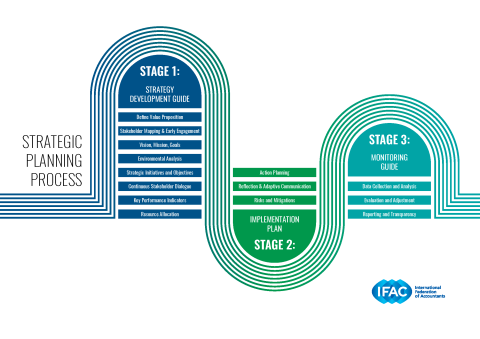
    IFAC-PAO-Strategy-Toolkit-2025-Planning-Process
    An overview of the strategic planning process outlined in the Toolkit.

    Lee White, IFAC Chief Executive Officer, said, “We’ve seen firsthand how a clear and dynamic strategy strengthens purpose, focus, and impact. This second edition of our toolkit builds on lessons from our own strategic planning process, emphasizing continuous learning, adaptability, and measurable value. It’s about helping PAOs turn strategy into action, ensuring they remain relevant and resilient in a rapidly changing environment.” 

    Jelena Misita, Chair of IFAC’s PAO Development Advisory Group, said, “We listened closely to PAOs using the first version, and one message was clear: they want to better define and demonstrate their value. The new edition integrates a Value Proposition Framework as an essential part of strategic planning, helping PAOs strengthen relevance, demonstrate impact more effectively, and align strategy and resources with their purpose.”

    Patrick Kabuya, Senior Financial Management Specialist, the World Bank, said, “We appreciate the opportunity to collaborate with IFAC in promoting and supporting the rollout of the updated toolkit. We believe this toolkit will help build stronger, more sustainable, and relevant PAOs, which are essential for fostering trust, accountability, and transparency — key factors in driving sustainable economic growth.”

    Sixto Coy, President, Institute of Chartered Accountants of the Caribbean (ICAC) said, “The Caribbean profession is strengthened when our PAOs have access to practical tools that help them plan strategically and deliver measurable value. IFAC’s updated toolkit reinforces our shared commitment to building trust, relevance, and resilience across the region’s accountancy profession.”

    The toolkit was officially launched today ahead of an IFAC Value Proposition workshop co-hosted with ICAC and the World Bank in Barbados. This marks the culmination of a global rollout that included soft launch workshops with the Fédération Internationale des Experts-comptables Francophones in Lyon in September and with the Saudi Capital Market Authority and the Saudi Organization for Chartered and Professional Accountants in Riyadh on October 1 during IFAC Connect MENA.

    We express our appreciation to Jelena Misita, Chair of the PAO Development Advisory Group, along with Berry Wammes, Chair of the Value Proposition Workstream, Panagiotis Alamanos, Chair of the Strategic Planning Workstream, and all workstream members for their leadership and valuable contributions.

    The IFAC PAO Strategy Planning Toolkit is available now in English with translations to Arabic, Dutch, French, and Spanish coming soon.

    Learn from the PAOs themselves how the toolkit has helped them become more resilient.

    About IFAC
    IFAC, by connecting and uniting its members, makes the accountancy profession truly global.

    IFAC member organizations are champions of integrity and professional quality, and proudly carry their membership as a badge of international recognition.

    IFAC and its members work together to shape the future of the profession through learning, innovation, a collective voice, and commitment to the public interest.

  • IFAC Report Finds Nearly All MENA Jurisdictions Advancing on Standards Adoption

    New York City | Riyadh English

    The International Federation of Accountants (IFAC) released the International Standards: 2025 MENA Insights Snapshot to benchmark international accountancy standards adoption and implementation trends across the Middle East and North Africa from 2019–2024. The report was launched at IFAC Connect MENA 2025 in Riyadh, co-hosted with the Saudi Organization for Chartered and Professional Accountants (SOCPA). 

    ifac-2025-mena-insights-snapshot


    The snapshot, available in English and Arabic thanks to translation by SOCPA, shows that adoption of international standards has accelerated significantly across MENA in recent years. Nearly all jurisdictions in the region have taken steps to align with International Standards on Auditing, International Financial Reporting Standards, and the International Code of Ethics for Professional Accountants. Several countries have made notable progress in embedding International Public Sector Accounting Standards into public sector reporting frameworks, reflecting growing recognition of the importance of transparency in government finances. 

    Differences in regulatory oversight, technical capacity, and resourcing are opportunities for advancement, particularly in public sector reporting and among smaller professional accountancy organizations.  

    Lee White, IFAC Chief Executive Officer, said: 
    “The 2025 MENA Insights Snapshot demonstrates both the progress and the challenges in ensuring that adoption progresses into implementation. IFAC Connect MENA is the perfect platform to launch this work, because the discussions here are focused on turning commitments into action, aided by the leadership of the accountancy profession. Adoption is a first step and real impact comes when standards are embedded in practice and serve the public interest.” 

    Dr. Ahmad Almeghames, CEO of SOCPA and IFAC Board Member, said: “We’re proud to see that Saudi Arabia is the only jurisdiction in the region to have adopted all seven baselines. This achievement reflects the Kingdom’s commitment to advancing the profession and aligning with the highest international benchmarks and serves as an example for the wider MENA region showing how strong leadership, investment in capacity, and collaboration across regulators, standard setters, and the profession can accelerate progress.” 

    The report will inform IFAC’s ongoing work with MENA member organizations, regulators, and development partners to strengthen capacity, accelerate adoption, and ensure consistent, high-quality implementation across the region. 

    Access the 2025 MENA Insights Snapshot in English and Arabic.  


    About IFAC 
    IFAC, by connecting and uniting its members, makes the accountancy profession truly global. 

    IFAC member organizations are champions of integrity and professional quality, and proudly carry their membership as a badge of international recognition. 

    IFAC and its members work together to shape the future of the profession through learning, innovation, a collective voice, and commitment to the public interest. 

  • Global Public Sector Shift to Accrual Accounting Steadies

    New York/London English

    The new International Public Sector Financial Accountability Index 2025 Status Report, published by the International Federation of Accountants (IFAC) and Chartered Institute of Public Finance and Accountancy (CIPFA) with support from the International Public Sector Accounting Standards Board (IPSASB), highlights steady, gradual progress in governments worldwide moving from cash to accrual-based financial reporting.  

    Accrual accounting provides governments with a clearer picture of their finances by recording the substance of transactions as they occur, rather than when cash transfers occur. This transparency helps inform decision-making and improves the ability to hold governments to account for their decisions. 

    Key findings of the report: 

    • By 2030, 56% of jurisdictions are projected to report on an accrual basis. This represents steady progress since the 2020 Index but at a slower pace than anticipated, reflecting the financial and operational strains governments faced during and after the pandemic. 
    • In 2024, high-income jurisdictions made up the majority of accrual adopters (57%), but by 2030, the landscape will shift. 60% of jurisdictions using accrual are projected to come from middle- and low-income economies. 
    • By 2030, 81% of accrual-reporting jurisdictions are expected to be applying International Public Sector Accounting Standards (IPSAS) either directly, with modifications, or as the foundation for national standards. 

    Lee White, Chief Executive Officer at IFAC said: "Accrual based reporting is essential for public sector transparency and accountability. It is also the foundation for the use of global IPSAS Standards. Our members fulfil a vital role in advising and supporting governments in their journey with the use of accrual accounting and global standards delivering clear accountability.” 

    Owen Mapley, Chief Executive Officer at CIPFA said: “Strengthening public financial management through accrual reporting is fundamental to addressing today’s fiscal challenges and building sustainable futures. It is encouraging to see the shift from cash to accrual has continued despite the impact of the pandemic.” 

    Ian Carruthers, IPSASB Chair said: “The increasing usage and influence of the IPSAS Standards underlines the importance of the shift in IPSASB’s new 5 year strategy towards maintenance of the standards suite, in particular through the recent establishment of the IPSASB Application Group.” 

    Explore the report.  

    About IFAC 

    IFAC, by connecting and uniting its members, makes the accountancy profession truly global. 
     
    IFAC member organizations are champions of integrity and professional quality, and proudly carry their membership as a badge of international recognition. 
     
    IFAC and its members work together to shape the future of the profession through learning, innovation, a collective voice, and commitment to the public interest. 

    About CIPFA 

    CIPFA, the Chartered Institute of Public Finance and Accountancy, is the professional body for people in public finance. Our 14,000 members work throughout the public services, in national audit agencies, in major accountancy firms, and in other bodies where public money needs to be effectively and efficiently managed. 

    About the IPSASB

    The International Public Sector Accounting Standards Board (IPSASB) works to strengthen public financial management globally through developing and maintaining accrual-based International Public Sector Accounting Standards (IPSAS Standards), IPSASB Sustainability Reporting Standards (IPSASB SRS™ Standards) and other high-quality financial reporting guidance for use by governments and other public sector entities. It also raises awareness of IPSAS Standards and IPSASB SRS Standards and promotes the adoption and implementation of these to enhance the quality and consistency of practice throughout the world and strengthen the transparency and accountability of public sector finances and sustainable development. The Board receives support from the Asian Development Bank, the Chartered Professional Accountants of Canada, the New Zealand External Reporting Board, the government of Canada, and The World Bank. The structures and processes that support the operations of the IPSASB are facilitated by the International Federation of Accountants (IFAC®). For copyright, trademark, and permissions information, please go to permissions or contact permissions@ifac.org.   

    New report captures current and future use of public financial reporting approaches by governments around the world

  • IPSASB eNews: September 2025

    New York, New York English

    The third Board meeting of the year was held from September 9 to 12, 2025, in Lisbon, Portugal.

    Thank you to hosts the Ordem dos Contabilistas Certificados (Order of Certified Accountants) for welcoming the IPSASB back to Lisbon and hosting both the September Board meeting and the 5th Public Sector Standard Setters Forum. The IPSASB also extends its thanks to its members, technical advisors, and standard setters from around the globe who joined the Forum to shape the future of public sector standard setting.

    Work Program Consultation


    With resources expected to become available in the second half of 2026, the IPSASB approved its Work Program Consultation to ask stakeholders about the most significant needs concerning financial reporting projects, post-implementation reviews, and sustainability reporting projects. The Consultation is expected to be published in October 2025 and will be open for 180 days. Please share your input and feedback on your priorities, so these can be considered in the decision-making process on developing the work program priorities for 2026 and beyond.

    IPSAS 33 – Limited Scope Update


    The IPSASB approved the updates to improve IPSAS 33, First-time Adoption of Accrual Basis International Public Sector Accounting Standards. These clarifications to the existing requirements make the guidance easier to apply for first-time adopters by emphasizing exemptions available, including adding new illustrative examples and implementation guidance. The pronouncement will be published in Q4 2025, and is effective January 1, 2028, with early adoption permitted.

    Definition of Material – Narrow Scope Amendments


    The IPSASB approved the Final Pronouncement, Definition of Material (Amendments to IPSAS 1, IPSAS 3, and the Conceptual Framework), enhancing the clarity and consistency of materiality throughout the IPSAS Standards. The amendments to IPSAS Standards are effective January 1, 2027, and amendments to the Conceptual Framework are effective upon publication of the pronouncement, which will occur in Q4 2025.

    Natural Resources


    The IPSASB has decided that a tangible natural resource held for conservation is a naturally occurring tangible asset that is managed to prevent its degradation. The IPSASB plans to approve the pronouncement during the December 2025 meeting in New York.

    Presentation of Financial Statements


    The IPSASB completed all remaining discussions regarding the general presentation requirements and those for the Statement of Changes in Net Assets/Equity. These discussions have allowed the IPSASB to continue progressing the development of most of the Consultation Paper (CP). Next quarter, the Board will tackle the last Chapter of the CP regarding note disclosures and continue developing the illustrative Exposure Draft.

    Strengthening Linkages Between IPSAS Standards and GFSM


    The IPSASB agreed to develop the non-authoritative guidance to help public sector entities maximize the extent to which they can use IPSAS Standards-based accounting data to compile statistical information. The work will continue next quarter, with the aim of approving the Exposure Draft at the December 2025 meeting.

    New and Returning Members


    High-quality standards that enhance public financial management and promote sustainable development globally need diverse voices to develop them. The Board continues to reflect broad geographic representation, gender parity, and professional expertise in public sector financial and sustainability reporting. Congratulations to our new and returning members for 2026.

    Meeting Videos

    Recordings of the meetings are available on our YouTube channel.

    Next Meeting

    The next IPSASB meeting will be in New York, New York, USA, from December 2-5, 2025.

    2025 Handbook

    The 2025 Edition of the Handbook of International Public Sector Accounting Pronouncements is out now. It contains the complete suite of IPSAS Standards published as of January 31, 2025,

    Building for the Future: Read the IPSASB Biennial Review 2023-2024


    The latest Biennial Review is out now: Building for the Future: The IPSASB Biennial Review 2023-2024. Over this review period, the IPSASB completed a number of significant long-running projects and have also finalized its 2024-2028 Strategy and Work Program.

    Adoption & Implementation Resource

    In collaboration with us, IFAC has published a new resource, Implementing International Public Sector Accounting Standards (IPSAS): IFAC Tools, a compilation of our resources designed to help governments and public sector entities adopt and implement IPSAS Standards and help Professional Accountancy Organizations (PAOs) advocate for their use.