  • New Global Principles from IFAC Put People at the Heart of a Thriving Accountancy Profession

    New York, New York English

    For the accountancy profession to thrive, everyone has a role to play—from organizations creating the right conditions and leaders setting the tone, to individuals taking an active role in building the capabilities and practices that enable them and those around them to thrive.

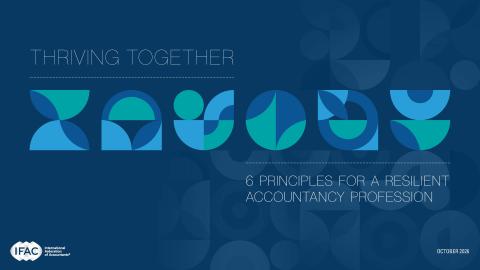
    New global principles launched today by the International Federation of Accountants (IFAC) put this shared responsibility into practice. Thriving Together: 6 Principles for a Resilient Accountancy Profession provides organizations, leaders, and individuals with a practical framework for creating healthy and sustainable professional environments.
    Image
    Cover of IFAC's Thriving Together

    The principles reflect growing recognition across the profession that wellbeing and professional capability are complementary. Supportive leadership, sustainable ways of working, opportunities for growth, and environments built on respect and trust all influence whether people can perform at their best over time—and whether they choose to build long-term careers in the profession.

    “Building a strong profession is about both attracting talented people and creating an environment where they want to stay, grow, and do their best work,” said IFAC Chief Executive Officer Lee White. “Organizations thrive when their people thrive. These principles are about being proactive and building on what the profession is already doing well and continually asking how we can do better.”

    The six principles call on the profession to:

    • Support Fulfilling Careers
    • Embed Sustainable Ways of Working
    • Promote Balance through Healthy Boundaries and Prioritization
    • Build Transparency and Trust
    • Ensure All Levels of Leadership Set and Model Culture
    • Empower Your People

    Underpinning them is a shared responsibility: organizations create the environment and conditions for wellbeing; leaders at all levels shape expectations and culture; and individuals actively build and sustain practices that enable them to perform at their best.

    The work builds on IFAC’s Opening Doors: Six Principles of Best Practice to Increase Access to Accountancy Qualifications, extending the focus from how the profession attracts and welcomes talent to the experience people have throughout their careers.

    The principles were developed by IFAC in collaboration with the Global Public Policy Committee, human capital professionals, professional accountancy organizations, educators, professional accountants in business, small- and medium-sized practices, early career professionals, and firms from across the global profession. They are designed to be practical and flexible, recognizing that there is no single approach to wellbeing across different people, organizations, cultures, and jurisdictions. Rather than prescribing a single model, they provide a common foundation for organizations and individuals to assess where they are today and identify opportunities to improve.

    Putting the Principles into Practice

    To help put the principles into action, IFAC has built a digital hub featuring wellbeing-focused resources from across the global profession. IFAC will continue to build on Thriving Together, expanding the resources available to help organizations and individuals assess where they are today, facilitate conversations, and identify practical opportunities for improvement.

    Thriving Together is intended as a starting point for continued progress—helping people build fulfilling careers, enabling organizations to sustain high performance, and strengthening the resilience of the profession for the future

    Access the Principles

    Read Thriving Together: 6 Principles for a Resilient Accountancy Profession.

    About IFAC

    IFAC, by connecting and uniting its members, makes the accountancy profession truly global. 

    IFAC member organizations are champions of integrity and professional quality and proudly carry their membership as a badge of international recognition. 

    IFAC and its members work together with the Forum of Firms and other key stakeholders to shape the future of the profession through learning, innovation, a collective voice, and commitment to the public interest.

    Principles Support Fulfilling Careers, Sustainable Performance, and a Resilient Profession

  • Thriving Together

    6 Principles for a Resilient Accountancy Profession

    These principles reflect growing recognition across the profession that wellbeing and professional capability are complementary. Supportive leadership, sustainable ways of working, opportunities for growth, and environments built on respect and trust all influence whether people can perform at their best over time—and whether they choose to build long-term careers in the profession.

    The six principles call on the profession to:

    IFAC
    English
  • Virtual Registration Opens for World Congress of Accountants 2026

    New York/Seoul English

    The International Federation of Accountants (IFAC) today announced the opening of virtual registration for the World Congress of Accountants (WCOA) 2026, hosted jointly with the Korean Institute of Certified Public Accountants (KICPA) from November 17–19, 2026, in Seoul, South Korea. Virtual participation will give professional accountants, students, business leaders, policymakers, academics, and interested members of the public around the world the opportunity to take part in the global profession’s flagship event.

    Virtual attendance includes:

    • Live access to all main-stage programming, including keynote addresses, plenary panel discussions, fireside chats, and other main WCOA sessions.
    • Live programming in Korea Standard Time (KST, UTC+9) for attendees who want to follow the event in real time.
    • On-demand access to recorded main-stage sessions after the event through Whova, the official WCOA 2026 event platform.
    • Perspectives from more than 30 global thought leaders, including Shin Je-yoon, Chairman of the Board of Samsung; Tom Hood, Executive Vice President, Business Growth and Engagement of AICPA; and Wes Bricker, Global Vice Chair - Global Chief Risk and Regulatory Officer at PwC. Session topics include, but are not limited to:
      • AI and the future of accountancy
      • Sustainable development and stronger institutions, and 
      • Attracting the next generation of leaders to the profession. 
    • Flexible access from anywhere in the world, allowing registered virtual attendees to catch up on main-stage programming at a time that works for them.

    Please note: Virtual registration does not include live access to concurrent breakout-room sessions. However, registered virtual participants will be able to access recordings of these sessions through Whova following the event.

    “WCOA has always been about bringing the global profession together, and virtual participation allows us to extend those conversations far beyond the room in Seoul,” said Lee White, Chief Executive Officer of IFAC. “Whether joining live or watching on demand from another part of the world, participants will hear different perspectives on the issues shaping our future and be part of a truly global conversation.”

    "We are delighted to host the first WCOA Congress under its new biennial format here in Seoul, bringing together representatives from around the world," said President Woon-Youl Choi of KICPA. "We hope this Congress sparks in-depth discussion on accounting, auditing, and sustainability, as well as the challenges and opportunities of AI-driven digital transformation, and that Korea's experience strengthening accounting transparency can help shape new value for future generations."

    Under the theme “Together for a Connected Tomorrow,” WCOA 2026 will bring together leaders from the accountancy profession and the wider financial ecosystem to explore the forces transforming economies, institutions, businesses, and the profession itself. 

    Register for virtual access to WCOA 2026 

    For the latest program information, visit ifac.org/wcoa.

    About IFAC

    IFAC, by connecting and uniting its members, makes the accountancy profession truly global.

    IFAC member organizations are champions of integrity and professional quality, and proudly carry their membership as a badge of international recognition.

    IFAC and its members work together with the Forum of Firms and other key stakeholders to shape the future of the profession through learning, innovation, a collective voice, and commitment to the public interest.

    About KICPA

    The Korean Institute of Certified Public Accountants (KICPA), established in 1954 under the Certified Public Accountants Act, is the statutory professional body representing Certified Public Accountants (CPAs) in Korea. Guided by the principle that sound accounting makes economic fundamentals sound, KICPA works to build trust and transparency in Korea's financial markets. Through setting professional standards, ensuring ethical conduct, and supporting continuous professional development, KICPA enables CPAs to serve the public interest, promote sound corporate governance, and contribute to Korea's economic development. KICPA is a member of the International Federation of Accountants (IFAC), the global home for the accountancy profession dedicated to serving the public interest.

    Global audiences can join the profession’s flagship event live from Seoul and access main-stage programming on demand

  • 2025 IFAC Annual Report

    Building Trust. Shaping the Future.

    IFAC’s 2025 Annual Report: Building Trust. Shaping the Future., highlights a year of collaboration, progress, and action to strengthen the global accountancy profession and prepare it for what comes next.

    IFAC
    English
  • IFAC Congratulates New IFRS Foundation Leadership Appointments

    New York, London English

    The International Federation of Accountants (IFAC) congratulates Steven Maijoor on his appointment as the next Chair of the IFRS Foundation Trustees, Sam Woods on his appointment as Chair of the International Accounting Standards Board (IASB), and Laura Forzani on her appointment as Managing Director of the IFRS Foundation.

    Together, these appointments mark an important new chapter for the IFRS Foundation as it continues to strengthen the global financial reporting architecture and support high-quality, internationally accepted standards.

    Lee White, Chief Executive Officer of IFAC, said:

    "I have been fortunate to work with Steven over many years in different capacities and have always valued his thoughtful leadership, deep expertise, and unwavering commitment to the public interest. I look forward to continuing our close collaboration in his new role as Chair of the IFRS Foundation Trustees.

    I also warmly congratulate Sam Woods on his appointment as Chair of the IASB. His extensive experience in financial regulation and international policy, together with his strong commitment to high-quality global standards, will serve the IASB well as it continues to meet the evolving needs of investors, businesses, and capital markets.

    And I congratulate Laura Forzani on her appointment as Managing Director. Her proven leadership and operational expertise will be a tremendous asset to the Foundation as it continues to evolve and deliver on its important mission."

    IFAC also extends its sincere appreciation to Erkki Liikanen for his outstanding leadership as Chair of the IFRS Foundation Trustees since 2018, guiding the Foundation through a period of significant growth and transformation. IFAC likewise thanks Andreas Barckow for his leadership of the IASB and his important contributions to advancing high-quality global accounting standards during his tenure. In addition, IFAC recognizes Michel Madelain for his service as Managing Director, including his leadership of the Foundation's transformation program that has strengthened its operations and positioned it well for the future.

    IFAC looks forward to continuing its strong partnership with the IFRS Foundation, the IASB, the ISSB, and the Foundation's leadership team in advancing high-quality international standards that serve the public interest and strengthen trust in global capital markets.

    About IFAC

    IFAC, by connecting and uniting its members, makes the accountancy profession truly global.

    IFAC member organizations are champions of integrity and professional quality, and proudly carry their membership as a badge of international recognition.

    IFAC and its members work together to shape the future of the profession through learning, innovation, a collective voice, and commitment to the public interest.

  • Onset of Mandatory Sustainability Requirements Begins to Impact Global Reporting, Study by IFAC, AICPA and CIMA Finds

    New York, New York English
    • ‘Fragmented landscape’ becomes a bit more structured with shift toward standardization and integration

    • Three-quarters of large global companies obtained assurance on at least some of their sustainability disclosures

    • The percentage of companies that used audit firms to perform assurance of sustainability information rose to 59% globally

    The global sustainability reporting ecosystem is becoming less fragmented as more of the world’s largest companies begin to adopt or form plans to use the International Sustainability Standards Board (ISSB) standards and European Sustainability Reporting Standards (ESRSs), an updated report from the International Federation of Accountants (IFAC), American Institute of CPAs (AICPA) and Chartered Institute of Management Accountants (CIMA) shows.

    The report, The State of Play: Sustainability Disclosure and Assurance (Six-Year Trends and Analysis, 2019-2024), is the sixth annual benchmark of sustainability reporting and assurance practices of global companies in G20 jurisdictions. Because the newest data in the report is from 2024, due to the typical lag for sustainability information, the results likely understate the extent of movement toward more uniform standards.

    “(T)he global reporting ecosystem is transitioning from a fragmented landscape toward one that is increasingly structured, standardized, and integrated,” the report summarizes. “However, this transition is not yet complete and may continue to be challenged by shifting geopolitical and regulatory sentiment within some of the world’s largest economies.”

    While global companies still use a patchwork of sustainability-related standards, the survey found progress in a number of areas:

    • A third of companies with sustainability information disclosures in 2024 referenced the use or future use of ISSB standards, compared to only 16 percent that did so the previous year. Turkey adopted the ISSB Standards beginning for fiscal year 2024 and several additional jurisdictions will implement ISSB requirements in reports that will be published in 2026.
    • Similarly, 20 percent of companies that disclosed sustainability information in 2024 said they used or plan to use ESRS, which suggests their implementation in the European Union may be having a cross-border impact.
    • Use of other standards and frameworks – the Task Force on Climate-Related Financial Disclosures (TCFD) framework, Global Reporting Initiative (GRI) standards and U.N. Sustainability Development Goals (SDG) – all fell by single digits between 2023 and 2024.

    "Around the world, we are seeing growing alignment behind high-quality sustainability reporting and assurance practices,” said Lee White, IFAC Chief Executive Officer. “This progress matters because trusted, decision-useful information supports better decisions, stronger organizations, and more efficient capital allocation. We expect this momentum to continue as stakeholders increasingly recognize the value of reliable sustainability-related information.”

    Among other highlights of the updated survey:

    • Ninety-seven percent of global companies had some form of disclosure of sustainability information in 2024, a percentage drop from the previous year.
    • Seventy-five percent of companies in the survey obtained assurance on their sustainability disclosures in 2024, up slightly from 73 percent the previous year. Most of the assurance performed was at a limited assurance level.
    • Audit firms continue to lead in providing assurance on sustainability disclosures by large global companies (59 percent of engagements, up four percentage points from last year), with broad variations country to country.

    “The growing use of audit firms for sustainability assurance is a good sign for capital markets and investors,” said Susan Coffey, CPA, CGMA, the CEO of public accounting for AICPA and CIMA. “Auditors have earned their reputation for trust and expertise, backed by strong professional certification programs and robust rules on audit, independence and professional integrity.”

    Seventy-six percent of companies reported sustainability information with financial disclosures in 2024 annual or integrated reports, up two percentage points from the previous year. Organizations that obtain assurance over sustainability information within their annual or integrated reports overwhelmingly use their statutory auditor to provide assurance over those disclosures.

    Mexico, Singapore and Turkey all had large increases in the percentage of audit firms performing assurance on sustainability information in 2024. The United States, meanwhile, had just under a third (32 percent) of sustainability-related assurance engagements performed by audit firms, up four percentage points from the previous year.

    About the Study

    IFAC, AICPA and CIMA partnered to understand sustainability reporting and assurance practices on a global basis by capturing reports containing environmental, social and governance (ESG) information in 22 jurisdictions. Some 1,400 companies were reviewed—one hundred from each of the largest six economies, with 50 companies reviewed in the remaining 16 jurisdictions. The current report includes data from 2019-2024.

    About the Association of International Certified Professional Accountants, AICPA, and CIMA

    The Association of International Certified Professional Accountants (the Association) advances the reputation, employability and quality of CPAs, CGMA designation holders and accounting and financial professionals globally. Founded in 2017 by the AICPA and CIMA, it represents 574,000 AICPA and CIMA members, students, and registrants in more than 150 countries and territories, advocating for the public interest and business sustainability on current and emerging issues.

    About the International Federation of Accountants

    IFAC, by connecting and uniting its members, makes the accountancy profession truly global.

    IFAC member organizations are champions of integrity and professional quality, and proudly carry their membership as a badge of international recognition.

    IFAC and its members work together with the Forum of Firms and other key stakeholders to shape the future of the profession through learning, innovation, a collective voice, and commitment to the public interest.

  • The State of Play: Sustainability Disclosure and Assurance

    Six-Year Trends and Analysis (2019-2024)

    This edition of The State of Play: Sustainability Disclosure and Assurance marks six years of benchmarking data and corresponding analysis. Our findings suggest the global sustainability reporting ecosystem is becoming less fragmented as more companies begin adopting, or preparing to adopt, the International Sustainability Standards Board (ISSB) Standards and European Sustainability Reporting Standards (ESRSs).

    IFAC
    English
  • Yong Sok Jhun

    Job Title

    IFAC Board Technical Advisor for Jungeun Shim

    Country

    Korea

    Yong Sok Jhun is a Technical Advisor for IFAC Board Member Jungeun Shim nominated by the Korean Institute of Certified Public Accountants (KICPA).

    Mr. Jhun is a Partner at Echon & Co., a member firm of Morison Global. He previously led the Audit & Assurance practice at Deloitte Korea. 

    In addition, Mr. Jhun is the President of Confederation of Asian and Pacific Accountants (CAPA) and currently serves as the Vice President for International Affairs and as a Board Member of KICPA. 

    Mr. Jhun received his bachelor's degree in business administration from Korea University and holds an MA in business administration from Soongsil University. He is a certified public accountant in Korea.

    Image
    ysjhun@e-chon.co.kr